
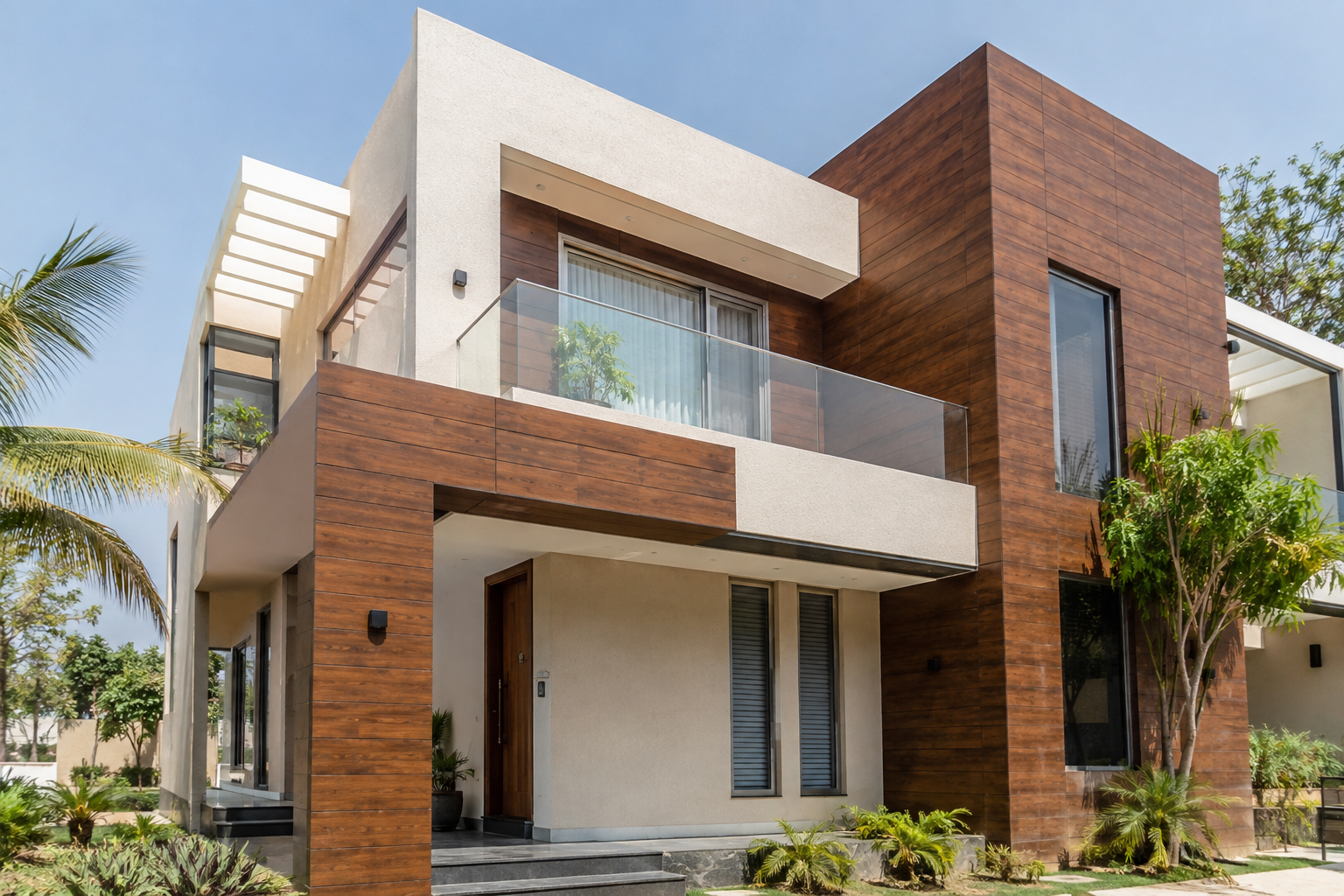
What Is an Exterior HPL Sheet?
An exterior HPL sheet is a high-pressure laminate panel specifically designed for outdoor architectural applications such as building facades, exterior walls, front elevations, balconies and feature cladding.
HPL stands for High Pressure Laminate. The material is produced by consolidating resin-impregnated paper layers under high pressure and temperature to create a dense, durable decorative panel.
The important distinction is between interior decorative laminate and exterior-grade HPL. Exterior applications expose a panel to sunlight, rain, humidity, dust and repeated temperature changes, so the product must be selected according to the conditions in which it will be installed.
For projects in India, exterior HPL is increasingly considered when the objective is to combine an architectural finish with a durable cladding surface.
Why Is Exterior HPL Different From Regular Interior Laminate?
Not every HPL or laminate product is intended for outdoor use.
An exterior-grade panel is selected according to the demands of the installation environment. Depending on the product specification, important considerations can include:
- Resistance to outdoor weather conditions
- UV and sunlight exposure
- Moisture and humidity
- Temperature variation
- Surface durability
- Colour and finish retention
- Appropriate thickness and fixing system
This is why buyers should never select an exterior cladding panel only by its appearance.
The grade, thickness, application suitability and installation system matter just as much as the decorative finish.
Why Is 6mm Exterior HPL Commonly Used?
Thickness is one of the first specifications to check when selecting exterior HPL.
HPLMAKER identifies 6mm as its most commonly used HPL thickness, while its FAQ also notes that other thicknesses can be customized depending on the application.
A 6mm panel provides a useful combination of rigidity, durability and practical handling for many exterior cladding applications.
For example, HPLMAKER’s 8010 exterior sheet is listed at 4 ft × 8 ft (1220 × 2440 mm) and 6mm thickness.
However, thickness should always be selected according to the specific system, structural requirements and manufacturer’s recommendations rather than assuming that one thickness is appropriate for every project.
Where Can Exterior HPL Sheets Be Used?
Exterior HPL can be used across residential and commercial architecture.
1. Front Elevations
HPL is frequently considered for modern residential elevations where designers want a wood, stone, concrete or contemporary decorative appearance.
It can be used selectively on:
- Entrance walls
- Feature bands
- Balcony sections
- Vertical facade elements
- Porch areas
- Architectural highlights
2. Exterior Wall Cladding
Instead of leaving an exterior wall with a plain painted finish, HPL can be introduced as a dedicated cladding surface.
This allows designers to combine different colours, textures and panel layouts.
3. Commercial Facades
Exterior HPL can also be considered for:
- Offices
- Retail spaces
- Showrooms
- Hotels
- Educational buildings
- Institutional projects
The design can be used across large facade areas or as accent panels.
4. Balconies and Feature Areas
A smaller installation can use HPL to create a distinctive visual element without cladding the entire building.
Wood-finish HPL, for example, can introduce a warm architectural appearance without using natural timber as the exposed exterior surface.
What Finishes Are Available?
One of the biggest reasons architects and homeowners consider HPL is the variety of visual finishes available.
Depending on the collection, exterior HPL can be available in designs inspired by:
Wood grain: for a warm, natural architectural appearance
Stone and concrete: for contemporary buildings
Solid colours: for clean modern facades
Metallic-inspired finishes: for architectural accents
Matte and textured surfaces: where a more refined appearance is required
HPLMAKER’s current product catalogue includes multiple numbered collections and finishes, including products such as 8010, 9007, 4190, 9012 and others.
Is Exterior HPL Suitable for Indian Weather?
This depends on the exact exterior-grade product and installation system.
India presents very different environmental conditions—from intense sunlight and high temperatures to heavy monsoon rain and coastal humidity.
Therefore, choosing exterior HPL should involve checking the manufacturer’s stated outdoor performance, warranty and installation recommendations rather than relying on a generic claim that every HPL product is suitable for every climate.
For example, HPLMAKER describes its exterior products as intended for outdoor applications and highlights resistance to environmental wear on its product pages.
How Is Exterior HPL Installed?
Exterior HPL is not simply a sheet that should be attached to a wall using an improvised fixing method.
The installation system should be designed according to:
- Building substrate
- Panel size
- Required ventilation
- Structural support
- Joint arrangement
- Fixing method
- Expansion and movement considerations
- Local environmental conditions
For larger facade projects, the installer should follow the manufacturer’s recommended fixing system.
The same sheet can perform very differently when installed correctly versus when the supporting structure, joints or fixing method are poorly executed.
Exterior HPL vs Paint
Paint is usually simpler to apply initially, but exterior HPL offers a different value proposition.
With HPL, the architectural finish is part of the panel itself rather than being dependent on repeatedly repainting the wall.
HPL can therefore be attractive for projects where the owner wants a defined decorative facade finish combined with a robust cladding material.
However, total project cost should include the panel, substructure, accessories, fabrication and installation, not just the sheet price.
Exterior HPL vs Natural Wood
Natural wood offers an authentic material character that is difficult to replicate perfectly.
Exterior HPL, however, can provide wood-inspired visuals while reducing some of the maintenance considerations associated with exposed natural timber.
The correct choice depends on:
- Design objective
- Budget
- Maintenance expectations
- Climate
- Required appearance
- Installation system
- Expected service conditions
For a modern facade, HPL can be an effective alternative where the appearance of wood is desired without specifying natural exposed timber.
How Do You Choose the Right Exterior HPL Sheet?
Before purchasing an exterior HPL sheet, check these seven things:
1. Confirm the grade
Make sure the product is actually intended for the planned outdoor application.
2. Check thickness
For many exterior applications, 6mm is an important specification to evaluate. HPLMAKER identifies 6mm as its commonly used HPL thickness.
3. Check sheet dimensions
HPLMAKER currently lists standard HPL sizes including 4 × 8 ft, with other sizes and customization options mentioned in its FAQ.
4. Select the right finish
Choose the texture and colour according to the architecture rather than simply selecting the most attractive sample.
5. Understand the fixing system
Ask how the panel will be supported and fixed before finalizing the material.
6. Check warranty and support
A warranty is useful only when the product specification, installation conditions and warranty terms are clearly understood.
7. Look at the complete project cost
Don’t compare manufacturers only on sheet price.
The final cost can also include:
HPL + supporting framework + cutting/fabrication + fasteners/accessories + installation + transportation
HPLMAKER Exterior HPL Sheets
HPLMAKER offers exterior HPL sheets in multiple designs and colours for residential and commercial applications.
For example, the HPLMAKER 8010 product is listed as a 6mm, 4 × 8 ft exterior HPL sheet with a wood-textured finish, intended for applications including modern elevations and exterior feature walls.
The current shop also lists a range of numbered HPL collections, allowing projects to select different surface appearances rather than relying on one standard design.
Explore HPLMAKER’s exterior HPL collection →
Frequently Asked Questions
Is exterior HPL the same as interior laminate?
No. Exterior applications require products specifically suitable for outdoor conditions. Always verify the manufacturer’s grade and application recommendation.
Is 6mm HPL good for exterior walls?
6mm is a commonly used HPLMAKER exterior thickness, but the correct thickness and fixing system depend on the project and installation requirements.
What size HPL sheets are available?
HPLMAKER’s FAQ lists 4 × 8 ft, 4 × 10 ft and 5 × 10 ft standard sizes, with customization also available.
Can HPL be used for a house front elevation?
Yes, exterior-grade HPL can be used for architectural facade applications including front elevations, provided the selected product and installation system are suitable for the application.
Does exterior HPL require maintenance?
Like any exterior facade material, it should be cleaned and maintained according to the manufacturer’s recommendations. The appropriate maintenance depends on the environment and installation.
Final Thoughts
Exterior HPL is not simply a decorative sheet. It is a complete architectural cladding material, and the result depends on much more than the design printed on the surface.
The right product should be selected by considering its exterior grade, thickness, finish, dimensions, installation system, warranty and expected environmental conditions.
For architects, builders and homeowners working on modern Indian facades, HPL can provide a practical way to combine design flexibility with a durable exterior surface.
The key is not simply choosing the most attractive sheet.
It is choosing the right exterior HPL specification for the right building and installing it correctly.